2026

2026. January 6.

The Dioceses and Bishops of Hungary (1804–1918). Institutional and Biographical Encyclopaedia V, eds. Zsófia Szirtes–Péter Tusor–Tamás Véghseő–Rupert Klieber, collaborator: Olivér Kőhalmi, Budapest 2026 (221 pp. + [18] pp. annotated b/w plates + [1] p. map supplement).

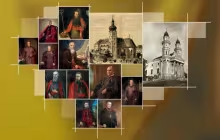
The new year sees the continuation – once again, at Epiphany (cf. here) – of the Bishops’ Lexicon (I–IV, CST I/7), published in 2025 and devoted to nineteenth-century Latin-rite prelates, with a volume presenting the biographies of the bishops of the Greek Catholic dioceses of Hungary. Spanning 210 pages, the book introduces 31 hierarchs from seven dioceses: Mukachevo, Prešov, Hajdúdorog, (Alba Iulia–)Făgăraș, Oradea, Gherla and Lugoj. (The eighth Greek Catholic diocese of the Kingdom of Hungary, Križevci, falls – together with the Roman Catholic dioceses of Zagreb, Bosnia-Đakovo, and Senj-Modruš – within the remit of Croatian historiography as part of the Vienna-based project.)

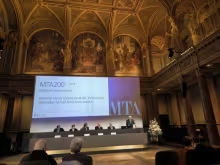
As with Chapters I–IV – presented on 8 October 2025 in the ceremonial hall of the Central Seminary and structured by Latin-rite ecclesiastical provinces (with a separate chapter for the Territorial Abbey of Pannonhalma) – the introductory descriptions of the Greek Catholic dioceses and the bishops’ biographies in Chapter V follow a uniform structure and methodological approach. Unlike the first volume, however, the dioceses here are classified and arranged according to the Greek rite rather than by ecclesiastical provinces. Beyond the strictly ecclesiastical (Catholic) historical narrative, the biographical entries also incorporate perspectives from political, cultural, social, economic, and nationality history. The varied application of these approaches, together with the evaluation of episcopal careers, makes the lexicon suitable not only for scholarly use but also for a broader readership.

The usability of the volume is enhanced by indexes of personal and place names. Several key figures and locations featured in Chapter V – constituting an independent volume of the Bishops’ Lexicon – are visually brought to life through a selection of archival photographs. The unified use of Chapters I–V of the two-volume lexicon (CST I/7 and I/9) and easier navigation are further facilitated by lists compiled according to three criteria: alphabetical order/page number, order of birth, and year of first appointment to office.

The Greek Catholic Bishops’ Lexicon is the result of genuine teamwork, involving 16 authors and collaborators. The editors are Zsófia Szirtes and Péter Tusor on behalf of the Fraknói Research Group, Tamás Véghseő from the Greek Catholic Heritage Research Group, and Rupert Klieber of the University of Vienna. Olivér Kőhalmi served as collaborator; Márton Varsa as proofreader; and the indexes were prepared by György Sági, Csongor Cziráki, Attila Hőgye and Olivér Kőhalmi. Alongside the diocesan introductions and biographical entries authored or co-authored throughout by Tamás Véghseő, the volume also reflects the contributions of Margit Balogh (introductions), Jaroslav Coranic (Eperjes), Volodymyr Fenych and Viktor Kichera (Munkács), Blanka Gorun-Kovács (Gyulafehérvár-Fogaras, Szamosújvár), György Gorun-Kovács (Nagyvárad, Lugos) and György Janka (Hajdúdorog).

The completion of the second volume of the Bishops’ Lexicon 1804–1918 also marks the beginning of a project spanning a millennium of history. Following the model of the German research project associated with Erwin Gatz, a biographical lexicon of Hungarian bishops from 1001 to 1993 will be produced. The planned volumes are: Bishops’ Lexicon 1918–1993; 1711–1804; 1605–1711; 1526–1605; 1458–1526; 1302–1458 and 1001–1302. In preparation for the Mohács anniversary year, the manuscript of the lexicon covering the Hunyadi–Jagiellonian period is already nearing completion (see the report by editor-in-chief Tamás Fedeles on this and on the project as a whole).

The complete volume, published jointly by the Vilmos Fraknói Research Group, the Gyula Moravcsik Research Institute and the Collegium Professorum Hungarorum, and issued by Gondolat Publishing House, is available as a free downloadable e-book via the link provided here.

2026. January 17.

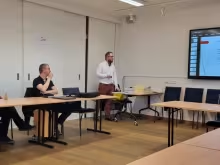
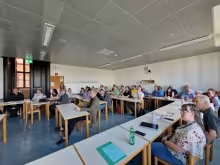
Between 16 and 18 January 2026, the Vestigia Research Group, in cooperation with the Institute of Historical Studies of Eszterházy Károly Catholic University (EKKE), organised a workshop in Eger, hosted in the university’s headquarter. Among the speakers were Viktor Kanász, Research Fellow of the Fraknói Research Group, and its demonstrator Olivér Kőhalmi.

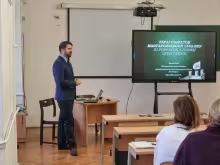
In his presentation, Viktor Kanász examined the little-known activities of papal troops in Hungary in 1542, drawing on previously unexplored sources from the Parma State Archives. Of particular importance are the letters written from Komárom and Vienna by Giovanni Angelo de’ Medici, the future Pope Pius IV, which provide valuable insight into the movements, supply conditions, and reception of the papal forces, as well as into King Ferdinand I’s further plans concerning their deployment. In addition, the lecture incorporated other source groups, including letters sent to Rome from Ragusa, which illustrate the more distant reverberations of military events and shed light on the specific nature of information arriving from the Ottoman capital.

Olivér Kőhalmi, together with Barnabás Guitman, Assistant Professor at the Institute of History of Pázmány Péter Catholic University (PPKE), delivered a joint paper entitled The Last Counsel of an Old Soldier. Their presentation analysed Giorgio Basta’s letter of 1606 addressed to Emperor Rudolf, in which the author argued against the Peace of Vienna, discussing its historical and political-theoretical line of reasoning. The speakers also identified the scribe responsible for drafting the letter and enriching it with historical and mythological exempla, as well as the works that served as its intellectual sources. A methodological peculiarity of the research lies in the fact that the Hungarian translation of the originally Italian text, as well as the resolution of the identity of a previously unidentified military officer, were achieved with the assistance of solution proposals generated by multiple artificial intelligence platforms.

The three-day workshop provided an opportunity for fruitful scholarly exchange among the participants, while also offering insight into the Italian connections, history, book culture, and built heritage of the archiepiscopal city of Eger.

2026. January 27.

In 2025, the volume Protagonisti e Collaboratori – Studiosi provenienti dall’Europa centro-orientale presso gli archivi della Santa Sede tra il 1881 e il 1918 (“Protagonists and Collaborators: Scholars from Central and Eastern Europe in the Archives of the Holy See between 1881 and 1918”) was published. The book contains the proceedings of the international conference held on 6 June 2024 at the Aventine headquarters of the Istituto Nazionale di Studi Romani, in the immediate vicinity of the headquarters of the Sovereign Military Order of Malta.

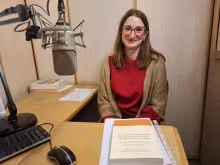
One of the editors of the volume, Katalin Nagy, who also serves as the Vatican archival research resident of the Fraknói Research Group, briefly presented the book on Vatican Radio in a conversation with Fr. László Vértesaljai. Vatican Radio has long served as an important forum for the Research Group to present its current scholarly results and to introduce Urbi et Orbi the latest volumes of the Hungarian Vatican historical series. (Recent appearances include broadcasts in 2025, 2024—see here, here, and here—and in 2023—see there, here, here, and here, among others.)

The radio interview can be listened to below.

The volume is available for free download here.

2026. February 12.

On 11 February 2026, the Fraknói Research Group, in cooperation with the Medieval Evenings lecture series, presented two newly published volumes by its members at its central research venue, the Faculty of Humanities of Pázmány Péter Catholic University. The books appeared in the Collectanea Vaticana Hungariae and Collectanea Studiorum et Textuum series.

The large audience was welcomed by Kornél Szovák, Director of the Cph, after which Tamás Fedeles’s volume Do All Roads Lead to Rome? The Ordination of Hungarian Clerics in the Roman Curia (1426–1523) was introduced. The speaker emphasized that the work, originally submitted as a doctoral dissertation for the Hungarian Academy of Sciences, is remarkably readable and of particular importance for its comprehensive and multifaceted use of an entire Roman source corpus. Its scholarly value is further enhanced by its appendices and its carefully designed cover. The book was also situated within both international and Hungarian scholarship and compared with Slovak research. While the latter preceded Hungarian historiography in examining this important archival fund, its results are uneven in quality and selectively interpret sources to support the present status quo, extracting them from their authentic historical and ecclesiastical-administrative context. With CVH I/25, and earlier with the related source edition (CVH I/18), the Fraknói Research Group has fulfilled a task of national strategic importance: the Vatican sources of Hungarian history have been explored, published, and interpreted as genuine sources of Hungarian history. The next step will be the Italian edition of the monograph, to be published by Edizioni Sette Città in Viterbo (Storia d’Ungheria, vol. 4).

This was followed by an appraisal from Academician László Solymosi of the medieval account book of the Győr cathedral chapter, edited for publication by Gábor Nemes. He placed the volume within the recent series of medieval source publications, noting that it offers not only ecclesiastical-historical data but also valuable material for economic, social, political, military, and everyday-life history. He also addressed the historiography of the edition, including the discovery of the source and the turbulent life of Jenő Házi, who began preparing it for publication, before congratulating the editor on this significant — and physically weighty — work.

Finally, Péter Tusor situated the Group’s scholarly series and the importance of the volumes within a broader context. The well-attended double book launch was closed by Kornél Szovák, after which participants had the opportunity to purchase the publications.

The CVH and CST volumes presented on this occasion are listed below:
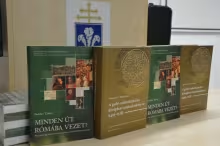
Fedeles Tamás: Minden út Rómába vezet? Magyarországi klerikusok felszentelése a római Kúriában (1426–1523) (Collectanea Vaticana Hungariae I/25), Budapest–Róma 2025.
† Házi Jenő–Nemes Gábor: A győri székeskáptalan középkori számadáskönyve (1495–1528) (Collectanea Studiorum et Textuum I/8), Győr–Budapest 2025. (Egyelőre nem a teljes e-kötet, annak közlése egy év múlva.)

Invitation and poster

2026. February 27.

The latest volume of the Collectanea Vaticana Hungariae series (CVH I/26) has been published under the title In the Shadow of Mohács: Two Decades in the History of Hungarian–Ottoman Affairs (1519–1541). The work is the book version of the author’s doctoral dissertation submitted to the Hungarian Academy of Sciences from the University of Szeged in 2024 and successfully defended in 2025 under the title From the Jagiellonians to the Szapolyais: Two Decades in the History of the Kingdom of Hungary (1519–1541). The official peer review—comprising the reports of István Tringli, Tibor Neumann, and Pál Ács, together with the author’s responses—can be consulted here.

The research underlying the volume is the author’s individual scholarly initiative and does not form part of the core research agenda of the Vilmos Fraknói Roman Historical Research Group. Nevertheless, beginning in 2017 and in the spirit of the “Mohács 500” commemorative framework, Tamás Kruppa received substantial FTE support within the Research Group for the collection of materials and the conduct of his investigations.

The book introduces a considerable body of newly examined sources—primarily from Rome and Venice—into the historiographical discourse and brings the half-century-long debate surrounding the so-called “Süleyman offer” to a new level. The choice of subject may be considered particularly bold, since the period of the Battle of Mohács belongs to the most intensively researched epochs of Hungarian historiography. Methodologically, the study moves beyond the conventional frameworks of Hungarian historical scholarship and approaches the events from a novel analytical perspective. On the basis of diplomatic sources, it advances the thesis that before 1526 all relevant actors—the Ottomans, the Jagiellonians, and the Habsburgs—acted pragmatically and to the best of their knowledge in shaping their respective foreign policies. The work argues that the long-standing explanatory model which contrasts a weak Hungarian political elite with a centuries-long Ottoman strategic design—and interprets the defeat at Mohács accordingly—is untenable.

The source base of the investigation consists of both previously published and newly identified Italian diplomatic texts. Owing to their distinctive rhetorical turns, these documents are not merely dispassionate descriptions of events; through their stylistic choices and silences their authors themselves shaped the course of developments. Consequently, they can be interpreted correctly only through careful, multi-layered decoding. On this basis, the monograph proposes a new interpretative framework, examining Hungarian–Ottoman relations between 1519 and 1541 from the perspective of the vassal relationship imposed upon Hungary by the Ottomans.

The e-book version of the volume can be downloaded here.

2026. March 4.

On 2 March 2026, on the occasion of the 150th anniversary of his birth, a commemorative conference dedicated to Pope Pius XII was held in the Sala dei Cardinali of the Oratory associated with the church of Santa Maria in Vallicella (Chiesa Nuova) in Rome. The solemn event brought together theologians, historians, and church dignitaries who reflected on the Roman roots of Eugenio Pacelli, his priestly and papal ministry, as well as his spiritual ties to the city and to St Philip Neri. The Fraknói Research Group was represented at the gathering by its Vatican archival research resident, Katalin Nagy, a collaborator of the Collegium Professorum Hungarorum (CPH).

The conference was presided over by Cardinal Dominique Mamberti, Prefect of the Supreme Tribunal of the Apostolic Signatura, who in his opening address emphasised the distinctly “Roman” character of Pius XII’s pontificate and his enduring fidelity to the city. The programme was moderated by Mario Prignano, chief editor of the RAI Tg1 news programme, who guided the audience through the proceedings while bringing both historical and pastoral aspects of the theme into discussion. The introductory remarks were delivered by Rocco Ronzani OSA, Prefect of the Vatican Apostolic Archive, who highlighted the significance of recent scholarly research for a deeper understanding of Pacelli’s life and legacy.

The first lecture, by Edoardo Cerrato, explored Pacelli’s relationship to the “Filippine spirituality” (Eugenio Pacelli e la spiritualità filippina), demonstrating how the young priest’s visits to the Chiesa Nuova and the Oratory shaped both his early ministry and his later papal service. Particular emphasis was placed on confession, liturgical life, and pastoral closeness—elements reflecting the enduring legacy of St Philip Neri.

This was followed by a presentation by Emilio Artiglieri, who addressed “The Places and Times of Eugenio Pacelli” (I luoghi e i tempi di Eugenio Pacelli). His lecture outlined with precision the Roman, familial, and legal environment in which the future pope’s vocation matured. From the Pacelli family’s legal traditions to service within the Holy See, the portrait that emerged was that of a figure firmly rooted in Roman culture yet open to the global challenges of the twentieth century.

A particularly personal contribution was offered by Orsola Pacelli, niece of Pius XII, whose testimony (Ricordi della famiglia Pacelli) evoked family memories and wove intimate personal recollections into the broader fabric of global Church history. Her moving reflections brought the figure of the “Pastor Angelicus” closer to the audience, presenting a personality shaped by a devout family milieu, discretion, and a remarkable sense of balance.

The conference concluded with a solemn transition to the church of Santa Maria in Vallicella, where at 7 p.m. Cardinal Mamberti celebrated a festive Holy Mass, accompanied by the musical performance of the Quartetto vocale della Fondazione Cardinale Bartolucci.

2026. March 6.

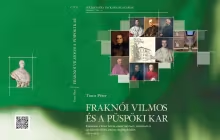
The latest volume of the Vatican–Hungarian historical series (Collectanea Vaticana Hungariae, CVH I/27) bears the title „Fraknói Vilmos és a püspöki kar. Küzdelem a Szent István római történeti, művészeti és egyházművelődési intézet megalapításáért (1910–1913)” (Vilmos Fraknói and the Hungarian Bishops. The Struggle to Establish the Saint Stephen Institute for Historical, Artistic and Ecclesiastical Studies in Rome (1910-1913). The monograph—supplemented with an extensive documentary appendix—forms part of the historiographical research carried out in connection with the Fraknói Centenary of 2024. Its principal findings were first presented at the close of the commemorative year in the framework of the 12th Fraknói Workshop Lecture, under the title „Fraknói Vilmos és a püspöki kar. A római történeti intézet alapítástörténetéhez” (Vilmos Fraknói and the Episcopate: Toward the Founding History of the Hungarian Historical Institute in Rome). That lecture, however, examined and analysed the events only up to the failure of the official foundation of Fraknói’s Roman historical institute in January 1912.

The present monograph offers the first comprehensive treatment of the entire subject. Its most significant result lies in demonstrating that the history of the proposed Hungarian ecclesiastical institute in Rome—an issue of considerable symbolic importance—allows for a deeper understanding of the intellectual horizons of the Catholic ecclesiastical elite at the turn of the twentieth century, while also revealing their internal divisions with far greater clarity than before. Through a dense body of evidence documenting the tension between a partly pragmatist, partly paternalist and aristocratic conservatism, on the one hand, and an organised ecclesiastical “progression”—represented and mobilised not only by Ottokár Prohászka but also by Vilmos Fraknói—on the other, the study demonstrates conclusively that Hungarian Catholicism around the turn of the century cannot be regarded as a monolithic entity. This conclusion remains significant even though both external circumstances and internal power relations changed profoundly after the First World War. In the Hungary of the late nineteenth and early twentieth centuries, Vilmos Fraknói himself represented a form of patriotic elitism marked by a pronounced sense of social responsibility, situated within the intellectual frameworks of Romantic historicism and modern Catholicism.

The history of Fraknói’s projected Roman institute and the successive institutional concepts associated with it reveal that the strengthening of Catholic identity at the fin de siècle was accompanied by processes of ideological segregation and clericalisation. The chronological framework of this development spans 1894–1914—from the establishment of a privately maintained institute at Fraknói’s own residence, through the attempt to create a state-academic private institute, to the ultimately unsuccessful efforts to found an institute under ecclesiastical patronage or with an explicitly ecclesiastical character.

Grounded firmly in historical research, the volume also succeeds in definitively dispelling and clarifying the confabulatory origin myths that currently connect several Hungarian institutions operating in the Eternal City with the name of Fraknói. The essence of this clarification is that while the concept formulated by Kunó Klebelsberg, centred on fostering Italian–Hungarian cultural and diplomatic relations, continues to shape the Hungarian institutional presence in Rome, Fraknói’s scholarly legacy lacks an institutional base in the Italian capital. No Hungarian ecclesiastical or state-supported historical research institute or artists’ house presently exists in Rome. At the same time, however, certain intellectual antecedents of the Pontifical Hungarian Institute—which maintains only a latent connection with Fraknói’s legacy and does not express it in its official self-definition—can be discerned in Fraknói’s February 1912 proposal, as well as in the negotiations conducted under the leadership of Bishop Károly Hornig until November 1912. Moreover, the Saint Stephen House may clearly be regarded as the actual—albeit partial—realisation of the scholar–abbot’s plan of 20 August 1910, which sought to revive the medieval tradition of the pilgrims’ house bearing the name of Saint Stephen. Paradoxically, this is precisely the institution that does not in any way trace its origins to Vilmos Fraknói.

Alongside these two principal historical arguments, the volume presents a series of smaller but illuminating findings related to Fraknói’s biography. Among other matters, the reader learns why he was compelled to leave Rome permanently in 1905, how his relations developed with his fellow canons in Nagyvárad (Oradea) and with Count Miklós Széchényi, the bishop of the diocese, as well as several details of his journey to India in 1910 and his visit to the United States in 1912. The study also discusses his plans for a synthesis in cultural history, his 1914 resignation from the abbacy of Szentjobb and from his canonry in Várad, and the rapid withdrawal of that resignation. These and similar episodes—many of which were either absent from or only briefly mentioned in the centenary memorial volume devoted to him—add further depth to the portrait of the scholar and churchman.

The intricate and thought-provoking sequence of events has thus far been presented in lecture form only up to January 1912. Fraknói’s subsequent new project—the plan for the Saint Stephen Institute for Ecclesiastical Culture in Rome—will be the subject of a forthcoming lecture to be delivered at the Saint Stephen Academy in the autumn of 2026.

The volume, edited by Olivér Kőhalmi, can be viewed and downloaded in full here.

2026. March 13.

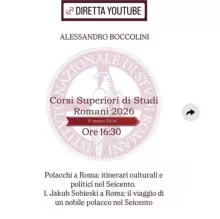
On 11 March 2026, the inaugural event of the new lecture series Polacchi a Roma: itinerari culturali e politici nel Seicento took place online under the auspices of the Istituto Nazionale di Studi Romani. The programme focused on the Roman journey of Jakub Sobieski (1592–1646) and its cultural and political dimensions. The lecture was delivered by Alessandro Boccolini, Professor of Early Modern History at the University of Tuscia (Università della Tuscia), a recognised specialist in relations between seventeenth-century Poland and the Holy See. He is a member of CESPoM (Centro Studi sull’Età dei Sobieski e della Polonia Moderna) and CIRVI (Centro Interuniversitario di Ricerche sul Viaggio in Italia), and serves as Editor-in-Chief of the international journal Eastern European History Review.

In his introductory remarks, Professor Boccolini emphasised that the Italian peregrinations undertaken by the Polish nobility in the seventeenth century represented a distinctive East-Central European adaptation of the aristocratic Grand Tour tradition that flourished across Europe. During his youthful travels between 1607 and 1613, Jakub Sobieski visited Italy, Spain, and France, pursuing studies aimed at acquiring theological, historical, and artistic knowledge. Sobieski recorded his stay in Rome in a detailed travel diary, which constitutes a unique source for understanding the Eternal City within the intellectual and religious milieu of the early Baroque period.

Particular attention was devoted to the political dimensions of such journeys. During the first half of the seventeenth century, the Roman visits of Polish noblemen and envoys could often be interpreted as missions of obedientia, serving as public demonstrations of fidelity and loyalty to the Holy See. Boccolini pointed out that this function was especially significant in the relationship between Catholic Poland and the papacy, and that similar ceremonial gestures accompanied the triumphal entries into Rome of Jerzy Ossoliński and Michał Radziwiłł.

In the concluding section of the lecture, Boccolini evaluated Sobieski’s travel diary not merely as a personal reflection but also as a diplomatic and cultural document. The text, in which Roman experiences emerge through the interweaving of knowledge, faith, and representation, provides an excellent illustration of how pilgrimage to Rome became an integral component of both the identity formation and the political experience of the Polish nobility.

The forthcoming lectures in the Polacchi a Roma series will present further examples of the Italian presence of seventeenth-century Polish diplomats and travellers, thereby contributing to a deeper understanding of the connections between Central Europe and Rome.

The lecture was followed on behalf of the Fraknói Research Group by Katalin Nagy, Vatican Archives Research Resident and staff member of the Collegium Professorum Hungarorum.
 

2026. March 25.

On 25 March 2026, the ceremonial hall of the Hungarian Academy of Sciences hosted the presentation of the festschrift inspired by the eightieth birthday of Professor László Solymosi, Member of the Academy. (László Solymosi: Studies on the Medieval History of the Kingdom of Hungary, ed. Attila Bárány, Gábor Dreska, László Szabolcs Gulyás, Ádám Novák, and Kornél Szovák, Hungary in Medieval Europe Research Group, University of Debrecen, Debrecen–Budapest, 2025.)

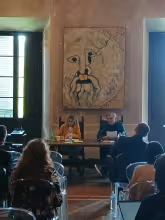
The large audience of colleagues, including members of Section II of the Academy, former students, admirers, and friends was welcomed on behalf of the bicentenary Hungarian Academy of Sciences by Gábor Kecskeméti. He was followed by Kornél Szovák—former student of the celebrant, Director of the Gyula Moravcsik Institute and the Collegium Professorum Hungarorum, and Professor at the Faculty of Humanities and Social Sciences of Pázmány Péter Catholic University—who presented the volume (his address may be read here). He emphasised that while László Solymosi’s scholarly legacy includes several source editions, a monograph, and a chronology, it is above all his studies that render his academic oeuvre truly distinctive. The newly published volume offers a rich selection of these writings, providing an excellent representation of both the celebrant’s principal fields of research and the trajectory of his scholarly career. The central focus of the collection, much like that of Solymosi’s life’s work itself, is the ecclesiastical history of medieval Hungary.

Kornél Szovák also drew attention to the physical appearance of the volume, noting that its design consciously harmonises with the collection published in honour of Professor Solymosi’s seventieth birthday in 2014. He pointed out that the studies, arranged in six thematic sections, encompass almost the entire medieval period, from the Árpádian era to the age of the Jagiellonians. He stressed that every contribution is characterised by meticulous scholarship, an abundance of source material, and methodological maturity. Alongside the many stimulating studies devoted to the Diocese of Veszprém and to Saint Ladislaus, he singled out as personal favourites two essays dealing respectively with the foreign journeys of Abbot Uros of Pannonhalma and the pilgrimage of Hungarian prelates to England in the thirteenth century.

The celebrant, who attended the event together with his wife and daughter Katalin, was subsequently greeted on behalf of the three universities that had supported the publication of the volume. The first speaker was Ildikó Horn, Director of the Institute of History at the Faculty of Humanities of Eötvös Loránd University. She recalled the academician’s professional and personal ties to ELTE, from his years as a student through his career as lecturer and department chair, and placed him among the ranks of the great medieval historians and mentors who preceded him, including Henrik Marczali, Elemér Mályusz, József Deér, András Kubinyi, and Ilona Bolla.

On behalf of the Faculty of Humanities and Social Sciences of Pázmány Péter Catholic University, Dean Nándor Birher praised (his address may be read here) the academician’s achievements. He highlighted the particularly important role Solymosi played during the 1990s in developing the medieval studies curriculum of the Faculty, first during its formative years on Ménesi Road and subsequently in Piliscsaba. As a result of these efforts, the Faculty produced its first Doctors of the Hungarian Academy of Sciences in the field of medieval studies, among them Norbert C. Tóth and Tibor Neumann. Beyond his teaching activities, Professor Solymosi consistently supported historical scholarship at Pázmány, a commitment reflected, among other achievements, in the long series of Vatican, international, and domestic publications produced by the Fraknói Research Group. Dean Birher also recalled a conversation in which the celebrant had stressed the importance of strengthening both the Catholic character of historical scholarship and the teaching and research of ecclesiastical history at a Catholic university. The Dean expressed his agreement with these aims and reaffirmed his commitment to their further promotion.

Finally, Attila Bárány, Professor at the University of Debrecen and the principal organiser of the volume, addressed the audience on behalf of his institution. He reminded those present that László Solymosi, born in 1944, remains an active scholar to this day, continuing to contribute to the university’s academic life through both his publications and his supervision of doctoral students. He shared with the audience that the idea for the volume had originated during the anniversary year of 2024 and had now come to fruition. At the same time, he expressed the hope that the studies omitted from the present collection, together with future contributions, might form the basis of another commemorative volume to be presented on 25 June 2034, on the occasion of the celebrant’s ninetieth birthday. His remarks were met with enthusiastic applause from the audience.

At the conclusion of the presentations, Professor Solymosi himself stepped to the podium of the ceremonial hall and shared memories of several defining moments from his academic and institutional career, while also reflecting upon the speeches delivered during the event.

The programme concluded with a reception and book-signing session. The Fraknói Research Group was represented at the event by members of staff from the Collegium Professorum Hungarorum.

Professor Solymosi, who has also been honoured with the Vilmos Fraknói Prize, has been a member of the editorial board of the Collectanea Vaticana Hungariae series since its establishment in 2002 under the chairmanship of Péter Erdő, then Rector of Pázmány Péter Catholic University. From the very beginning, he has been a regular participant and contributor to the events organised by the Fraknói Research Group, both in Budapest and, most recently, during the Fraknói Centenary celebrations held in Nagyvárad (Oradea) and Rome in 2024 (see: here, here, here, here and here). He is also the dedicatee of Volumes I/910 of the Collectanea Vaticana Hungariae series, the Cameralia volumes published on the occasion of his seventieth birthday.

Ad multos annos!
 

2026. April 2.

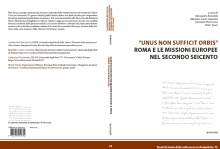
The collective volume Unus non sufficit orbis". Roma e le missioni europee nel secondo Seicento has been published as the 13th volume in the Studi di storia delle istituzioni ecclesiastiche series by Sette Città, edited by Alessandro Boccolini, Massimo Carlo Giannini, Giovanni Pizzorusso, and Péter Tusor.

The volume contains the written versions of the papers delivered at the international conference “Unus non sufficit orbis”: Roma e le missioni europee nel secondo Seicento, held online on 12 December 2025 under the organisation of Pázmány Péter Catholic University, in collaboration with the Istituto Nazionale di Studi Romani (INSR), several Italian universities, and the Fraknói Research Group. The conference was connected to the critical edition of the key 1678 report by the Secretary of the Congregation for the Propagation of the Faith (Relazione di Monsignor Urbano Cerri alla Santità di N. S. Papa Innocenzo XI dello Stato di Propaganda). A detailed description of the project is available here.

A long-standing and close working relationship exists between the Fraknói Research Group and the INSR, in particular with its director Gaetano Platania, as well as with the Centre for Central European and Papal History at the University of Tuscia in Viterbo (Professors Matteo Sanfilippo and Alessandro Boccolini). The principal milestones of this collaboration are the jointly organised international symposia. These include, most recently, the conference series Barberini e l'Europa and I Collegi per stranieri a Roma (16th–20th centuries), as well as the scholarly conference held on the occasion of the Fraknói centenary, Protagonisti e Collaboratori – Studiosi provenienti dall’Europa centro-orientale presso gli archivi della Santa Sede tra il 1881 e il 1918 (see here for its Roman reception). The papers presented at these conferences have been published, with the participation of the Research Group, in the form of edited volumes by Edizioni Sette Città (Viterbo), and are available there.

(A full list of joint conferences: 2007 Rome [proceedings: CVH I/4], 2013 Budapest, 2018 Budapest, 2019 Rome, 2021 Rome, 2022 Rome, 2023 Rome, 2024 Rome.)

The volume can be freely accessed and downloaded here.

2026. April 20.

On 20 April 2026, the public doctoral defence of György Sági, research assistant—now research fellow—and scientific secretary of the Fraknói Research Group, was held at the Doctoral School of History of the Faculty of Humanities and Social Sciences, Pázmány Péter Catholic University.

The public defence of his PhD dissertation, entitled The History of the Archdiocese of Kalocsa–Bács during the Episcopal Governance of Archbishop József Grősz (1943–1961), was conducted before a committee chaired by György Domokos, with Barnabás Guitman serving as secretary. The official opponents were Mons. Tamás Tóth and Andor Lakatos, while the committee members included Miklós Jávor and Viktor Kanász.

Both the choice of topic and its execution offer an exemplary illustration of those identity-specific research opportunities and responsibilities that constitute one of the central missions of a Catholic university. The pursuit of such scholarly tasks likewise stands at the core of the activity of the Fraknói Research Group, of which the candidate has been an increasingly important member in various capacities for nearly a decade and a half.

The dissertation was awarded the highest distinction, summa cum laude (100%), by the committee.

Supervisor: Péter Tusor.

The dissertation is available here, and the theses can be accessed here.

2026. May 4.

On 4 May 2026, during the Dies Academicus of the Saint Athanasius Greek Catholic Theological College in Nyíregyháza, a presentation was held of the lexicon volume devoted to the Greek Catholic dioceses and bishops of the nineteenth-century Kingdom of Hungary, published in the Collectanea Studiorum et Textuum series of the Fraknói Research Group in cooperation with the Greek Catholic Heritage Research Group.

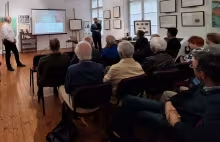
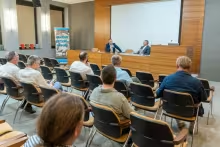
Within the scholarly section of the Saint Athanasius Day celebrations, Thomas Németh, professor at the University of Vienna, and András Dobos, rector of the seminary and lecturer at the Saint Athanasius College, presented and assessed the volume before a large audience that included Greek Catholic bishops, faculty members, students, and seminarians. Three of the editors of the work were also present at the book launch: Tamás Véghseő, as well as Péter Tusor and Zsófia Szirtes representing the Fraknói Research Group, together with the editorial assistant Olivér Kőhalmi.

Thomas Németh first outlined the structural conception of the Greek Catholic Bishops’ Lexicon, whose framework consists, diocesan by diocesan, of concise introductory studies followed by chronologically arranged episcopal biographies. This mirrors exactly the structure of the first volume, published in 2025, which contains the material of the ecclesiastical provinces of Esztergom (I), Kalocsa (II), Eger (III), together with Pannonhalma (IV). He highlighted that the present Greek Catholic chapter (V), issued as an independent volume, concludes with extensive indices of places and names, a concordance list facilitating unified use of Chapters I–V—divided into separate Latin and Greek volumes according to ecclesiastical-administrative units—as well as a photographic appendix and map supplement. The individual entries consistently reflect the perspectives of two authors, which contributes to the nuance and richness of the texts; one of the co-authors in every case is Tamás Véghseő. Németh also stressed the scholarly importance of the extensive bibliographies and source lists appended to each episcopal biogram.

In his presentation of the volume, András Dobos expressed his satisfaction that essential biographical and diocesan-historical data—previously scattered, incomplete, and lacking systematic synthesis—have now been published in a form both worthy and highly readable. Covering 31 bishops from seven dioceses (Munkács, Eperjes, Hajdúdorog, Fogaras and Gyulafehérvár, Nagyvárad, Szamosújvár, and Lugos) across 210 pages, the publication represents not only an important scholarly reference work for historians, but also an informative and engaging volume accessible to a wider interested readership. He noted that future readers may even approach the book as continuous reading, something rarely associated with lexicons as a genre.

At the close of the event, Research Group director Péter Tusor briefly outlined the international—primarily Austrian and German—cooperative framework within which the volume had come into being. He explained that the Greek Catholic dioceses of Hungary had been omitted from the 2020 Berlin edition (Duncker & Humblot) because a later decision by the Vienna-based general editor, Professor Rupert Klieber, reassigned them to a projected future volume encompassing all Greek Catholic and Orthodox dioceses and bishops of the Habsburg Monarchy. The Fraknói Research Group, however, considered it essential that the Hungarian episcopate of the “long nineteenth century” should be presented in an integral and historically authentic form; for this reason, the material concerning the Hungarian Greek Catholic dioceses was published independently in its present form. Tusor concluded by expressing his gratitude to his fellow editors and to all contributors to the lexicon volumes for their dedicated and high-quality work.

Like the other publications of the Fraknói Research Group, the volume is freely accessible and available in e-book form:

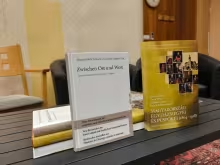
The Dioceses and Bishops of Hungary (1804–1918). Institutional and Biographical Lexicon V (CST I/9), ed. Zsófia Szirtes – Péter Tusor – Tamás Véghseő – Rupert Klieber, assistant editor: Olivér Kőhalmi, Budapest, 2026. (Magyarország egyházmegyéi és püspökei (1804–1918). Intézménytörténeti és életrajzi lexikon V (CST I/9), szerk. Szirtes Zsófia–Tusor Péter–Véghseő Tamás–Rupert Klieber, mts. Kőhalmi Olivér, Budapest 2026.)

A further report and photo gallery are available on the website of szentatanaz.hu


Magyar Kurír

Poster

2026. May 11.

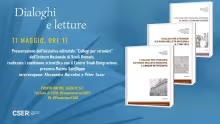
On 11 May 2026, an online round-table discussion was held to present the volumes containing the proceedings of the conference series I Collegi per stranieri a Roma. Organised jointly by the Istituto Nazionale di Studi Romani and the Centro Studi Emigrazione, the discussion was moderated by Matteo Sanfilippo and featured the participation of the two editors, Alessandro Boccolini and Péter Tusor (Tusor’s reflections are available in Hungarian here and in Italian here).


The three volumes presented on the occasion were the following:
–  I collegi per stranieri a/e Roma nell’ età moderna. I: Cinque-Settecento, edited by Alessandro Boccolini – Matteo Sanfilippo – Péter Tusor (Studi di storia delle istituzioni ecclesiastiche, 10), Viterbo: Sette Città, 2023.


– I collegi per stranieri a/e Roma nell’ età moderna. II: 1750-1915, edited by Alessandro Boccolini – Philippe Roy-Lysencourt – Matteo Sanfilippo – Péter Tusor (Studi di storia delle istituzioni ecclesiastiche, 11), Viterbo: Sette Città, 2024.


I collegi per stranieri a/e Roma. III: Dopo la grande guerra, edited by Alessandro Boccolini – Philippe Roy-Lysencourt – Matteo Sanfilippo – Péter Tusor (Studi di storia delle istituzioni ecclesiastiche, 12), Viterbo: Sette Città, 2025.
(The latter volume has now also become available online.)


In the course of the discussion, Péter Tusor reflected on the origins of the long-standing scholarly cooperation between the Fraknói Research Group, the Istituto Nazionale di Studi Romani, and the Centre for Central European and Papal Historical Studies at the University of Tuscia in Viterbo, emphasising that the Vatican Archives constituted the original point of convergence for this collaboration. Its principal milestones have been the jointly organised international symposia, including most recently the Barberini e l'Europa series, the I Collegi per stranieri a Roma conferences (16th–20th centuries), and the scholarly conference Protagonisti e Collaboratori – Studiosi provenienti dall’Europa centro-orientale presso gli archivi della Santa Sede tra il 1881 e il 1918, organised on the occasion of the Fraknói centenary. The papers presented at these conferences have subsequently appeared, with the participation of the Research Group, in edited volumes published by Edizioni Sette Città in Viterbo.


Tusor concluded by noting that he and Professor Boccolini are currently working on the forthcoming, already twenty-eighth volume of the Collectanea Vaticana Hungariae series.
(Complete list of the joint conferences: Rome 2007 [proceedings: CVH I/4], Budapest 2013, Budapest 2018, Rome 2019, Rome 2021, Rome 2022, Rome 2023, Rome 2024, Rome 2025.)


2026. May 29.

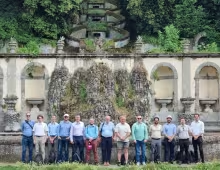
Between 17 and 25 May 2026, the Fraknói Research Group held its customary annual institutional week in Rome. As in 20232024, and 2025, the Saint Stephen House (Szent István Ház) once again served as the group's base of operations, symbolically continuing the revival of the Hungarian Historical Institute in Rome. From there, participants set out each day to conduct research in the city's major archival and library collections.

A total of thirteen researchers affiliated with the Fraknói Research Group and the Collegium Professorum Hungarorum (CPH) carried out archival and bibliographical research in the Vatican Apostolic Archive, the Vatican Apostolic Library, the Historical Archive of the Secretariat of State, the Archives of Saint Stephen House, and the library of the French Institute in Rome.

On Wednesday, during the General Audience, Péter Tusor, Leader of the Research Group, presented Pope Leo XIV with a volume devoted to the history of Hungarian scholarship in the Vatican archives. He also requested the Holy Father's blessing upon the members of the Research Group and the CPH present at the audience, as well as upon their future scholarly endeavours. The Pope graciously thanked Tusor for his brief introduction and gift, and gladly imparted his Apostolic Blessing.

In keeping with established tradition, members of the Research Group also visited Vatican Radio, where Balázs Rétfalvi presented the two volumes of the nineteenth-century Bishops’ Lexicon, while Péter Tusor introduced his recently published monograph (CVH I/27) to Fr. László Vértesaljai S.J. and the listeners of the Hungarian-language broadcast. (The latter interview is available here from 12:00.)

The youngest members of the Research Group ensured that the most recent volumes published within the Collectanea Vaticana Hungariae series and by the Viterbo-based scholarly network—including Vilmos Fraknói and the Episcopate Vilmos Fraknói and the Hungarian Bishops, The Dioceses and Bishops of Hungary (1804–1918) Vol. V, and Protagonisti e collaboratori—found their way into the libraries of Rome’s and the Vatican’s leading research institutions and historical collections.

After the closing hours of the archives and libraries, as well as during the weekend, the study trip was enriched by visits to the seemingly inexhaustible cultural treasures of Rome. Particular highlights included the Bernini exhibition at Palazzo Barberini, together with excursions to Frascati, Orvieto, Ancona, and Loreto. These shared experiences provided a fitting complement to more than a week of intensive scholarly work.

During the institutional week, the Research Group also held its annual planning meeting in Frascati, dedicated to preparing its programme for the 2026/27 academic year. The meeting itself was preceded by an unexpected episode: the entire group briefly sought refuge in a rapid retreat—evoking the exploits of Hungary’s great historical figures—when a number of wild boars appeared to be charging through the grounds of Villa Torlonia. It soon became clear, however, that the animals were merely making their way to the park’s Baroque fountain for a drink. (Photographs and video of the incident are available on the Fraknói Research Group’s Facebook page.)

As photography is not permitted in the Vatican archival reading rooms, the research itself will ultimately be documented through its scholarly publications. The remainder of the study trip, however, is illustrated in the photo gallery below.

2026. June 4.

On 3 June 2026, Viktor Kanász, Research Fellow of the Fraknói Research Group, delivered a public lecture entitled From Rome to Mohács: Papal Troops in the Ottoman Wars at the Balaton Museum in Keszthely as part of the museum’s lecture series Ottoman Evenings at the Museum.

The audience was welcomed by the Museum’s director, Sándor Décsey, after which the speaker presented the diplomatic and financial means through which the Holy See supported the anti-Ottoman struggle in Hungary. He then offered a detailed overview of those military campaigns in which either mercenary forces financed by the Papal States fought on the Hungarian theatre of war or military units arrived directly from the Papal States themselves.

Particular attention was devoted to the campaigns of 1526, 1532, 1542, and 1543, as well as to the Long Turkish War and the major operations of the Wars of Liberation. In addition, the lecture examined the archival sources relating to these campaigns, with special emphasis on the results of research conducted in the collections of the Vatican Archives.

Combining military, diplomatic, and ecclesiastical history, the presentation highlighted the often-overlooked role played by the papacy not only as a diplomatic actor but also as a direct contributor to the military efforts undertaken against Ottoman expansion in Central Europe.


POSTER

(Pictures: Balatoni Múzeum)

2026. June 5.

On 3 June 2026, Gábor Nemes, Senior Research Fellow of the Fraknói Research Group, delivered a lecture entitled From Petition to Bull: An Introduction to Papal Diplomatics at the Archabbey of Pannonhalma as part of the Latin Diplomatic Language Seminar Week organised by the Collegium Professorum Hungarorum.

At the beginning of his presentation, Nemes outlined the documentary and administrative system of the Roman Curia, introducing the structure, functions, operation, and personnel of the Apostolic Chancery, the Signatura, and the Dataria. Following an overview of the various stages involved in the issuance of papal bulls, the audience itself became actively engaged in the workshop. Through the detailed content-based, linguistic, and palaeographical analysis of two early sixteenth-century Hungarian-related documents issued during the pontificate of Pope Julius II, participants gained practical insight into the curial document-production process discussed in the introductory section. Through their questions and observations, they also contributed to the collaborative nature of the seminar, assisting the lecturer in reflecting on several minor interpretative issues connected with the two papal briefs that form part of a forthcoming source edition.

The CPH’s medieval Latin course, held for the second time between 1 and 5 June, was complemented in the middle of the week by a two-day study visit to Pannonhalma. In addition to Nemes’s seminar, the programme included further lectures, visits to the Archabbey’s collections—including its archives, library, and museum—as well as guided tours of the basilica and monastic complex.

The opening and closing days of the course took place at the Stephaneum, the CPH’s campus in Piliscsaba. Among the participants were researchers from the Zsigmond Jakó Research Institute of the Transylvanian Museum Society, several of whom had also contributed lectures to last year’s Fraknói Academy.

2026. June 8.

On 8 June 2026, the latest research findings on the schools and religious houses of the former Austrian Jesuit Province were presented at the seminar of the Institute for Austrian Historical Research (Institutsseminar des Instituts für Österreichische Geschichtsforschung) at the University of Vienna, in the form of a combined book and project presentation.

As part of the event, editor István Fazekas introduced the volume Höhere Bildung in den Jesuitenschulen Mitteleuropas am Beispiel der Universität von Tyrnau (PUGW XXIV, Vienna, 2025). The collection includes contributions by two members of the Fraknói Research Group, Péter Tusor and Róbert Oláh P., entitled “Pázmánys Universitätsgründung und das Problem ihrer päpstlichen Anerkennung” (pp. 155–170) and “The Educational Background of the Canons of the Győr (Raab) Cathedral Chapter between 1658 and 1783” (pp. 245–261), respectively. The volume explores the history of Jesuit secondary and higher education, with particular emphasis on the University of Trnava (Nagyszombat) and its wider educational network. Through contributions published in both English and German, it seeks to situate the history of Jesuit institutions within broader Central European and Habsburg-monarchical contexts.

The second presentation was delivered by Zsófia Kádár, who introduced the database Religious Houses of the Austrian Jesuit Province. Developed within a postdoctoral research project conducted at the Institute for Austrian Historical Research since 2021, this ambitious online resource provides structured descriptions of approximately thirty religious houses belonging to the former province and is intended to serve as a foundation for future scholarship.

In the introductory part of the programme, András Oross, Editor-in-Chief of the series, presented the aims and achievements of the Publikationen der ungarischen Geschichtsforschung in Wien (PUGW), the principal publication series of “Hungarian historical research in Vienna” — or, equally, “Viennese Hungarian historical scholarship.” The deliberately ambiguous German title reflects the fact that the series publishes, in considerable numbers, studies of international significance that are not necessarily based on research conducted in Vienna itself.

Oross also discussed and analysed the series’ emblematic illustration, created by Géza Xantus in the artist’s home at Csíksomlyó (Transylvania). (Xantus was likewise responsible in Rome for the copper engraving that later served as the basis of the Collectanea Vaticana Hungariae emblem.) The image depicts not only the Hungarian royal and Austrian imperial crowns, but also a Hungarian turul soaring behind the double-headed eagle.

The Viennese series of Hungarian historical scholarship was founded in 2009 on the intellectual and typographical foundations developed for the Collectanea Vaticana Hungariae, through the initiative and organisational efforts of István Fazekas and Péter Tusor. The Viennese sister series of the Roman-based CVH was formally introduced in Hungary in 2018. One of its most significant volumes was presented in the spring of 2024 at the Hungarian Embassy in Vienna, housed in the former palace of the Hungarian Court Chancellery. (For further information on the relationship between the CVH and the PUGW series, see our news reports from 2018 and 2024.)

From its foundation until 2022, the PUGW lacked a dedicated series editor. Thanks to the efforts of András Oross, however, this important international forum of Hungarian historical scholarship has gained renewed momentum over the past four years. Its presentation at the University of Vienna, within the prestigious seminar framework of the Institute for Austrian Historical Research, offered compelling evidence of this continued vitality.

The Fraknói Research Group was represented at the event by Péter Tusor, one of the founding members of the PUGW editorial board.
 

POSTER

2026. June 11.

Fraknói Research Group Represented at International Conference on Barberini Rome

Between 10 and 12 June 2026, the Istituto Nazionale di Studi Romani, the Fondazione Camillo Caetani di Sermoneta, and the Biblioteca di Storia Moderna e Contemporanea jointly hosted an international conference in Rome entitled Dal trionfo al tracollo? La Roma barberiniana e il mondo (1623–1644) (“From Triumph to Collapse? Barberini Rome and the World, 1623–1644”).

At this prestigious scholarly gathering, Péter Tusor, Leader of the Fraknói Research Group, delivered a paper entitled Tra politica e religione. L'episcopato ungherese e la questione della residenza vescovile sotto Urbano VIII (“Between Politics and Religion: the Hungarian Episcopate and the Question of Episcopal Residence under Urban VIII”).

In his presentation, Tusor examined how the issue of episcopal residence became intertwined with the political conflicts between the Holy See and the Habsburg Monarchy during the pontificate of Pope Urban VIII. Particular attention was devoted to the cases of Cardinals Gaspare Borgia and Péter Pázmány between 1632 and 1634, and especially to the controversy surrounding György Lippay between 1638 and 1642. The latter case gave rise to a prolonged diplomatic struggle between Rome and the Viennese court over whether the bishop could remain in Vienna while serving as chancellor. These episodes vividly illustrate how, in the seventeenth century, political considerations frequently overrode canonical principles on both sides and contributed to the strengthening of a specifically Hungarian ecclesiological outlook that emphasized the autonomous, “Apostolic” character of the Hungarian Church rooted in the legacy of Saint Stephen.

The conference, dedicated to the Barberini era, was held at three distinguished Roman venues: the Aventine headquarters of the Istituto Nazionale di Studi Romani, well known to members of the Research Group; the sixteenth-century Palazzo Caetani near Piazza Argentina, home of the Fondazione Camillo Caetani; and the imposing Palazzo Mattei, which houses the Biblioteca di Storia Moderna e Contemporanea.

International scholarly cooperation in Rome remains a priority for the Fraknói Research Group. Thanks to nearly two decades of active collaboration with leading Italian institutions—including the Istituto Nazionale di Studi Romani  and the Università degli Studi della Tuscia—the Group has participated in numerous joint research initiatives, international conferences (most recently in Budapest in 2018 and in Rome in 2019, 2021, 2022, 2023, 2024, and 2025), and collaborative publications. Several of these volumes now appear within the Storia d'Ungheria – History of Hungary series, launched in 2025 by Edizioni Sette Città.

The conference programme may be consulted here, while the written handout of the lecture is available here.

A recording of Péter Tusor’s lecture, delivered in Italian, can be accessed below.
 

2026. June 26.

The Fraknói Research Group, in cooperation with Pázmány Péter Catholic University, the University of Pécs, the Pécs Regional Committee of the Hungarian Academy of Sciences, and the Collegium Professorum Hungarorum, organised the 12th Fraknói Summer Academy between 25 and 27 June. This year’s venue was the city of Pécs. The programme focused on late medieval Hungarian ecclesiastical history, centring on the forthcoming 500th anniversary of the Battle of Mohács and the preparation of the Bishops’ Lexicon of the Hunyadi and Jagiellonian periods.

At the opening of the event, Péter Tusor, Head of the Research Group, welcomed the audience. He was followed by Prof. Márta Font, speaking on behalf of the Pécs Regional Committee of the Hungarian Academy of Sciences, who praised the achievements of the Research Group and its successful scholarly activities both in Hungary and abroad. Finally, Tamás Fedeles, Vice-Rector of the University of Pécs, Co-Director of the Fraknói Research Group and Chief Curator of this year’s Summer Academy, greeted the participants at the headquarters of the Regional Committee.

The opening session continued with a round-table discussion moderated by Kornél Szovák, Director of the Collegium Professorum Hungarorum, the publisher of the volume. During the discussion, editors Tamás Fedeles and Norbert C. Tóth presented the forthcoming Bishops’ Lexicon, scheduled for publication at the end of the summer to coincide with the anniversary of Mohács. They discussed the circumstances surrounding the preparation of the volume, the successful coordination of its twenty-two contributors, and the structure of the work, including its biographical entries and introductory essays on diocesan history. Following a presentation of the project’s principal findings and innovations—including the incorporation of newly identified Italian and Hungarian sources—the speakers also outlined their long-term plans, namely the preparation of further volumes covering historical periods not yet represented in the series.

The opening afternoon concluded with an interview conducted by Tamás Fedeles with László Felföldi, Bishop of Pécs, tracing the principal stages of the bishop’s life and vocation. The discussion touched upon his youth in the Nyírség region and his journey from a career as an electronics technician to the priesthood. Bishop Felföldi spoke at length about his appointment to the Diocese of Pécs, the concerns he initially experienced, and the hospitality of the local community, which greatly facilitated his integration into his new surroundings. The conversation also highlighted several important initiatives introduced since his episcopal ordination, including the diocesan men’s gatherings and the training programmes established for candidates preparing for the ministry of acolyte.


The following day, Tamás Fedeles opened the series of conference papers with a lecture entitled The Prelates of the Kingdom of Hungary at the Twilight of the Middle Ages. He surveyed the episcopal appointment policies of the Hunyadi and Jagiellonian rulers and the changes they underwent over time, highlighting the profound rupture caused during the reign of King Matthias by the loss of royal confidence following the conspiracy of humanist prelates against the monarch. He also presented the principal characteristics of the seventy-five bishops examined in his research, including their service to the Crown in diplomatic and courtly capacities, their social and ethnic origins, their educational backgrounds and peregrinations, and the dual loyalty that fundamentally shaped their careers: fidelity both to the reigning monarch and to the pope. In conclusion, he addressed the “prestige hierarchy” of the dioceses, as well as the relationship between spiritual authority and temporal wealth.

The next presentation was delivered by Tamás Pálosfalvi, Senior Research Fellow at the Institute of History, who examined the career of Dénes Szécsi, Archbishop of Esztergom (1440–1465). His lecture explored aspects of the archbishop’s political career that could not be discussed in detail in the corresponding entry of the forthcoming Bishops’ Lexicon. He therefore addressed the beginnings of Szécsi’s ecclesiastical career and the role played by his family during the civil war that broke out in 1440. Particular attention was devoted to the relationship between Archbishop Dénes and Governor John Hunyadi, as well as to the factors that fundamentally shaped this connection. The lecture also sought to answer two longstanding questions that scholarship has yet to resolve satisfactorily: why Archbishop Dénes failed to attain a more significant role in government after 1453, and whether the assumption that his relationship with King Matthias deteriorated after 1459 can be substantiated. The final conclusion of the presentation, echoing the assessment of Professor András Kubinyi, was that Dénes Szécsi was not only a conscientious churchman but also a moderate and respected statesman who played an important role in preserving peace during the turbulent decades between 1442 and 1464.

Norbert C. Tóth, Chief Archivist of the Hungarian National Archives and Head of the HUN-REN–MNL–SZTE Hungarian Medieval Studies Research Group, presented a paper entitled The History of the Archdiocese of Kalocsa-Bács between 1520 and 1529 (Part I: The Archbishopric under Royal Administration). His lecture examined the history of the archdiocese during the vacancy of the see between the death of Archbishop Gregory Frangepán in August 1520 and the appointment and subsequent occupation of the archiepiscopal seat by Pál Tomori in October 1522. Following Archbishop Gregory’s death, King Louis II immediately confiscated the revenues of the archdiocese and placed them under royal administration, directing them towards the war effort against the Ottomans. An excellent insight into this period is provided by six surviving registers, primarily produced in the course of administering tithe revenues. These documents record not only the collection of tithes village by village but also the allocation of these revenues in kind, including grain, flour and wine. The personal names preserved in these sources for the year 1522 were published by István Szabó in 1954 (Tithe Registers of Bács, Bodrog and Csongrád Counties), although the accounts themselves were not analysed. The registers make it possible both to reconstruct the economic and military functioning of the archdiocese and to gain a detailed picture, over the course of a quarter year, of the distribution of its revenues and expenditures.

Gábor Nemes, Director of the Győr Diocesan Collections Centre and Senior Research Fellow of the Fraknói Research Group, began his paper on the bishops of Győr in the late Middle Ages with an overview of the ecclesiastical topography of the episcopal city, which belonged at the time to a diocese of lower-middle-ranking income. He discussed the role of the cathedral chapter and of the bishop—whose residence remains in the episcopal castle to this day—in the life of the city, before analysing the origins, family backgrounds, education (including academic peregrinations and degrees obtained), and careers of seven bishops of Győr, from Ágoston Salánki to Balázs Paksi. He emphasised that the bishops of Győr generally emerged either from the ecclesiastical middle ranks—particularly from archdeaconries, provostships, and above all from the chapters of Buda and Esztergom—or from among royal officials and clerical diplomats in royal service. For many, the next step in their careers led to the more prestigious episcopal see of Eger or even to the archiepiscopal throne of Esztergom. In conclusion, he addressed the western humanist networks maintained by the bishops of Győr and their patronage of the arts, which found tangible expression, among other achievements, in the renovation of the cathedral.

Viktor Kanász, Permanent Director of the Fraknói Academy, delivered his lecture The Diocese of Várad at the End of the Middle Ages in the unusual format of a live video call. The Assistant Lecturer of the Faculty of Humanities and Social Sciences at Pázmány Péter Catholic University, and researcher at both the Fraknói Research Group and the Military History Institute and Museum, examined the condition of the diocese in the decades preceding the Battle of Mohács. His presentation explored the diocesan administrative system, the functioning and revenues of its chapters, and the religious orders established within its territory. He discussed in detail the central role of Várad, the history of its cathedral, and the regionally significant activity of the cathedral chapters as places of authentication. In this context, he also highlighted the book culture of the diocese, the educational characteristics of late medieval Várad, its advanced cathedral school, and the university attendance patterns of clergy originating from the diocese. Particular emphasis was placed on the fact that Várad became a major pilgrimage destination owing to the tomb of Saint Ladislaus. Thanks to these factors, by the turn of the fifteenth and sixteenth centuries Várad had become the wealthiest bishopric in the kingdom after Esztergom, while also serving as the centre of a flourishing humanist milieu. In contrast, the period after Mohács brought dramatic change: as a result of the Protestant Reformation, Ottoman expansion, and the emergence of the Principality of Transylvania, Várad was transformed from a prosperous episcopal centre into a heavily contested frontier fortress within a war-torn region.

The lecture The Bishops of Veszprém in the First Quarter of the Sixteenth Century by Balázs Karlinszky, Director of the Archdiocesan Library and Archives of Veszprém, was presented in absentia through the interpretation of Csongor Cziráki. After outlining the condition of the Diocese of Veszprém at the close of the Middle Ages, the presentation introduced the bishops of the Jagiellonian period, highlighting among them Albert Vetési, one of the era’s most distinguished diplomats. The lecture addressed their social backgrounds, education, careers, and achievements both within the diocese and in national politics. Karlinszky also discussed several important monuments of the cultural history of the bishopric, including the Nágocs Codex preserved in the Archiepiscopal Library of Veszprém, the account book of the cathedral chapter, and the volume recording the decrees of the diocesan synod of 1515. The presentation concluded with a survey of material artefacts from the period, including the Vetési chasuble, the heraldic column capital known as the “Vetési Stone,” and several altars from Veszprém.

In his lecture on the key turning points of the career of László Szalkai, Bálint Lakatos, Senior Research Fellow of the Medieval Studies Research Group, expanded upon the biographical entry he had prepared for the Bishops’ Lexicon. He examined the atypical features of Szalkai’s career as a former financial administrator, economic expert, and royal secretary who eventually rose to the archiepiscopal see of Esztergom. Particular attention was paid to the combination of financial and chancery responsibilities that characterised his career, the factors behind his remarkably rapid advancement, and his participation in the royal campaign and the Battle of Mohács in 1526. The lecture concluded with an analysis of the identification and political symbolism of the Szalkai coat of arms based on impressions of his signet seals. The shield is divided horizontally: the upper field contains a demi-eagle facing dexter, while the lower field bears a floating heraldic fleur-de-lis. Although the colours of the arms are unknown, biographical evidence suggests that the eagle in the upper field was silver. This would indicate that, like several other influential royal confidants, Szalkai was granted the privilege of incorporating the eagle associated with the Jagiellonian dynasty into his coat of arms as a mark of special royal favour—a distinction fully consistent with the trajectory of his career.

Balázs Ternovácz of the Budapest City Archives examined the impact of Ottoman expansion on the functioning of the two southern missionary bishoprics of the Kingdom of Hungary in his paper entitled The Dioceses of Syrmia and Bosnia in the Shadow of the Ottoman Conquest. Originally established to support the missionary expansion of the Latin Church, the dioceses of Syrmia and Bosnia increasingly found their activities shaped by the advance of the Ottomans from the fourteenth century onwards. While the Diocese of Syrmia gradually lost its effective missionary function as a consequence of Ottoman territorial gains, in Bosnia pastoral responsibilities were progressively assumed by the Franciscan vicariate, even as the bishop continued to maintain his legal claim to jurisdiction over the diocese. The lecture demonstrated that the Ottoman conquest resulted not only in territorial losses but also fundamentally transformed the operation and role of these missionary bishoprics.

The presentations devoted to individual dioceses continued with a paper by Gábor Buják on the Diocese of Nyitra. He discussed the unusual organisational structure of the bishopric, founded in the early twelfth century, and analysed the development of episcopal revenues throughout the medieval period. These factors largely determined the extent to which the diocese contributed to the maintenance of cavalry contingents assigned to frontier defence. He concluded by examining the activities of two pre-Mohács bishops of Nyitra, István Erdődi (1504–1512) and István Podmanicki (1512–1530), focusing primarily on their roles in national politics and the defence of the realm. In his concluding remarks, Buják emphasised that although the Diocese of Nitra lay far from the regions directly threatened by Ottoman expansion before 1526, both the diocese and its bishops nevertheless contributed to the defence of the kingdom despite their relatively modest financial resources.

The conference concluded with a lecture by István Kovács of the Institute of National Heritage, who offered an overview of the history of the Diocese of Csanád before the Battle of Mohács, with particular attention to the activities of two of its bishops, Miklós Csáki and Ferenc Csaholyi. His analysis addressed the characteristics of diocesan administration, revenues, and religious life. The presentation concluded with a reconstruction of the careers and ultimately tragic destinies of these prelates, culminating, in the case of Ferenc Csaholyi, in the ultimate sacrifice on the battlefield of Mohács in defence of Christian Europe.

Following the conclusion of the scholarly sessions and the lively and productive discussions that accompanied them, Friday evening saw the traditional ecclesiastical history quiz that has become an indispensable feature of the Fraknói Summer Academies. This year four teams tested their knowledge in a wide-ranging competition covering diverse historical periods and topics. At the end of the contest, the prize-winning teams—as well as those who narrowly missed the podium—were able to select volumes from the Collectanea Vaticana Hungariae (CVH) and Collectanea Studiorum et Textuum (CST) series as rewards. Equally important to the unique atmosphere of the event were the informal conversations that unfolded around the dinner table and throughout the evening, bringing together students of Pázmány Péter Catholic University with the institute researchers and university lecturers participating in the conference.

On the morning of the final day, Gábor Bertók, Director of the Janus Pannonius Museum, delivered a lecture presenting the latest results of the archaeological investigations of the battlefield of Mohács. Following a brief historiographical introduction outlining earlier phases of research, he paid particular tribute to the pioneering work of archaeologists László Papp, Borbála Marác, József Szűcs, and Béla Kiss. He then discussed the role played by the museum in Pécs in the ongoing project, the results achieved thus far in the investigation of the settlement of Földvár, and the excavation of previously identified mass graves, especially Graves III and IV. The lecture also highlighted new methodological approaches in archaeology and the invaluable contribution of metal-detector surveys, which have brought about a decisive breakthrough in battlefield research. As part of the interactive presentation, participants had the opportunity to handle both an original fragment of a firearm recovered during the excavations and a modern replica.

Following the lecture, participants were given a guided tour by Gábor Bertók of the Janus Pannonius Museum’s permanent exhibition on the history of Pécs, entitled The Spirit of the Place – Genius Loci. The three-day Fraknói Summer Academy concluded on Saturday during a communal lunch, when the three curators—Tamás Fedeles, Péter Tusor, and Kornél Szovák—offered their closing reflections and expressed their hope of continuing the programme next year in Piliscsaba, more precisely at the Collegium Professorum Hungarorum. After 2022, the theme of the Thirteenth Fraknói Summer Academy, marking the beginning of a new five-year research cycle, will once again be the multifaceted relationship between Hungary and the Holy See.


Galleries: day 1 – day 2 – day 3

(Video recordings of the lectures may be viewed below and on YouTube.)

cover image : a Pécsi Egyházmegye honlapja

The Twelfth Fraknói Summer Academy was supported by the Faculty of Humanities and Social Sciences of Pázmány Péter Catholic University (Kut-23-6), the Collegium Professorum Hungarorum, the University of Pécs.

Poster