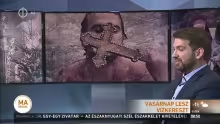
Viktor Kanász, assistant research fellow of the Fraknói Research Group, gave an interview on Hungarian M1 TV channel about the history of Epiphany feast day. He also mentioned that Pope Gregory XV. established the Congregatio de Propaganda Fide on 6 January 1622, day of Epiphany.
2019
2019. January 3.
2019. January 9.
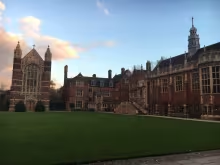
Péter Tusor, leader of the Fraknói Research Group, gave a lecture at the international conference "Monarchy and Modernity since 1500", organised by the University of Cambridge.
Péter Tusor contributed by chairing the panel "Monarchy in the Seventeenth Century", and he also gave a lecture titled "Apostolic Rights of a Catholic Monarch? The Hungarian Royal Patronage and Supremacy (1417–1918)". The script of his lecture can be accessed here.
2019. January 16.
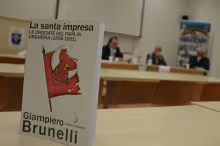
The Fraknói Research Group organised the presentation of the book "La santa impresa. Le crociate del papa in Ungheria (1595-1601)" by Giampiero Brunelli on 16 January 2019.
In his introduction, Giampiero Brunelli mentioned the phenomenon what Hungary meant in the end of the 16th century for Europe. He pointed out that the pope and the leaders of the time all realised that the border of Europe goes through Hungary, and all of their military campaigns to protect the culture of Christianity necessarily focused on Hungary as well.
The author was followed by Tamás Kruppa, senior research fellow of the research group. He praised the book and he stated that this volume counts as a big step towards the research of the era, and previous historians haven't payed enough attention towards the military politics of the Holy See.
Márton Szovák correlated his findings from Italian archives through the Vestigia-project with the new volume, reviewing the letters of Ercole Torbidi.
In his closing words Péter Tusor, leader of the Fraknói Research Group, underlined the importance of the foreign scientific results concerning Hungarian history, and he also stated it's crucial that the research group contributes greatly in this matter.
2019. February 1.
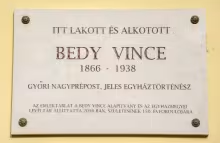
Nemes Gábor, research fellow of the Fraknói Research Group, organised a wreath laying and commemoration on 1 February 2019, the 80th death anniversary of Vince Bedy, prebendal provost of Győr and church historian.
2019. February 5.
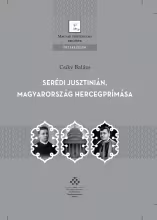
A new volume of Collectanea Studiorum et Textuum has been published: „Jusztinián Serédi, the Prince Primate of Hungary” by Balázs Csíky. More information about the book and parts of the volume can be accessed here.
Balázs Csíky departed young, and his career only couldn't achieve it's peak because of the short time which was given for him. He was a member of our previous "Lendület-project", and after his death in 2016, Krisztina Tóth, research fellow, finished his script about Jusztinián Serédi.
2019. February 15.
Terézia Horváth, assistant research fellow of the Fraknói Research Group, gave a lecture at the "XVI. János Szentágothai Multidisciplinary Conference and Student Competition" on 15 February 2019 in Pécs. The title of her lecture was "The Personnel of the Vasvár Chapter during the Reign of King Matthias".
She took first place in her section by the rating of the jury.
2019. February 15.
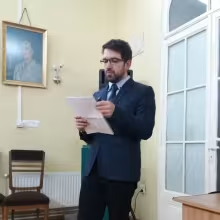
Two members of the Fraknói Research Group participated at the international conference "Church and Society in Late Medieval Transylvania (14th–16th Centuries)" in Cluj-Napoca (Kolozsvár) on 15 February 2019.
Tamás Fedeles, senior research fellow of the research group, in his lecture titled "The Transylvanian Diocese and the Apostolic Chamber during the Reign of King Sigismund of Luxembourg" (read by Viktor Kanász) gave insight into three important segments of the relation between the Diocese and the Apostolic Chamber: the various taxes, the ad limina visitations and the ordainments of the Curia.
Viktor Kanász, assistant research fellow of the research group, also gave his own lecture "The Sources on the Process of György Fráter’s Murder in the Vatican Archives", in which he analysed the documents and sources about the murder of Georgius Martinuzzi, and the enquiry initiated at the Holy See, specifically the confession of Miklós Oláh, primate of Hungary.
At the end of the conference, one of the research group's volumes, Regesta Supplicationum 1522–1523, got presented to the audience.
2019. March 5.
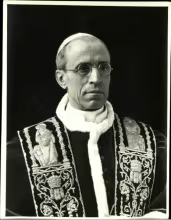
It's been a long awaited announcement what happened now, namely that the access of Vatican Secret Archives' sources about the papacy of Pius XII (1939–1958) will open to researchers from 2 March 2020.
Leader of the Fraknói Research Group, Péter Tusor gave an interview to Vatican Radio, where he stated it is not expected from a scientific point of view that the image of Pius XII will change considerably regarding his actions during World War II. The documents which serve the most crucial informations about this matter have already been open for researchers with a special permit. In fact, a research group (with the participation of Pierre Blet, Robert A. Graham, Angelo Martini and Burkhart Schneider) between 1965–1981 already launched a series of 11 volumes, in which they published and analysed the most important documents (Les Actes et documents du Saint-Siège relatifs à la Seconde Guerre mondiale, it can be accessed here).
Despite this the opening of the archives' files is a welcomed act among historians, including Hungarian scholars, because some questions could be clarified and a much boarder context could be given about the archbishop appointment of József Mindszenty and his later arrest, the stand of the Vatican during the Hungarian revolution of 1956 and the ecclesiastical governing of the territories which reunited with Hungary between 1938–1940. It is also a possibility that new details will be found on the expulsion of Apostolic Papal Nuncio Angelo Rotta in 1945 and the questions about the restoration of diplomatic relations between Hungary and the Holy See during the creation of the communist regime.
Since the mission and goal of our research group is the uncovering of Vatican sources on Hungarian matters, we look forward to the research which will follow.
2019. March 8.
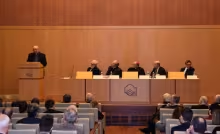
The international historian community of Rome could finally get to meet with the new monumental volumes "Incorrupta monumenta Ecclesiam defendunt" (Collectanea Archivi Vaticani 106, 107, 108, 109.) on 8 May 2019 at the Istituto Patristico Augustinianum in Rome. On the occasion of S.E.R. Sergio Pagano's (bishop-prefect of the Vatican Secret Archives) 70th birthday, the four new volumes got published, and they contain 206 studies on almost 3600 pages. The studies are organised thematically, and they were written by historians all around the world. Our research group contributed with three papers to this monumental work.
Tamás Fedeles: Ecclesiastical Career of the Apostolic Collector Petrus de Monasterio
Tamás Kruppa: Franciscans or Jesuits: Attempts to Resurrect Catholicism in Transylvania (1589-1592)
Full details of the mentioned book:
Incorrupta monumenta ecclesiam defendunt. Studi offerti a mons. Sergio Pagano, prefetto dell’Archivio Segreto Vaticano I–IV (Collectanea Archivi Vaticani 106–109), a cura di Andreas Gottsmann – Pierantonio Piatti – Andreas E. Rehberg, Città del Vaticano 2018.
vol. I. La Chiesa nella storia. Religione, cultura, costume (tom. 1–2), pp. XLVI, 1747.
vol. II. Archivi, Archivistica, Diplomatica, Paleografia, pp. XVIII, 938.
vol. III. Inquisizione romana, Indice, Diplomazia pontificia, pp. XVIII, 704.
vol. IV. Indice generale, pp. XVIII, 339.
2019. March 21.
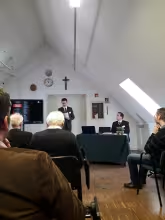
The Fraknói Research Group represented itself by several members at the conference The Effects of the Hungarian Soviet Republic on the Catholic Dioceses held in Veszprém on 21 March 2019.
Research fellow Krisztina Tóth analysed a memorandum about the organisation of the military chaplaincy written by István Zadravecz OFM in 1919, which was written for the request of Miklós Horthy.
External member Mátyás Varga gave a lecture on the relations of the parishioners and priests towards the Hungarian Soviet Republic in 1919 through the Historia Domus documents of the parishes in the Diocese of Székesfehérvár.
External member Máté Gárdonyi contributed to the conference by chairing the third section.
2019. March 22.
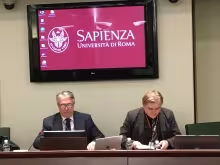
The Università di Sapienza in Rome organised a conference (Italian Peninsula and Central-Eastern Europe between Middle Ages and Early Modern Era. Economy, Society, Culture) between 21–22 March 2019.
Péter Tusor, leader of the Fraknói Research Group, and Tamás Fedeles, senior member, held presentations.
Tamás Fedeles: Hungarian candidates ordained in the Roman Curia during the Late Mediaeval Period
The lectures will be published in an upcoming volume. Contributing to the project coordinated by Prof. Andrea Fara is an important task for our research group.
2019. April 3.
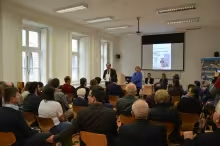
The newly published book "Serédi Jusztinián, Magyarország hercegprímása" ("Justinian Serédi, the Prince Primate of Hungary") was presented to the public on 3 April 2019 at the Pázmány Péter Catholic University in Budapest. The book presentation, which also served as a memorial for Balázs Csíky, author of the volume, was organised by the Fraknói Research Group. The volume fits into the research group's series Collectanea Studiorum et Textuum, and Magyar Történelmi Emlékek. Értekezések, which belong to the Hungarian Academy of Sciences.
Balázs Csíky (1978–†2016) related to our research group (previously called as the HAS-PPCU ‘Impetus’ Church History Research Institute) from 2015 as research fellow, and contributed with the research he was doing at the Vatican Archives on Angelo Rotta, papal nuncio, and Jusztinián Serédi, prince primate of Hungary. He aimed and worked to publish his PhD thesis (which he successfully defended in 2010 and received the degree summa cum laude), but due to his early death in 2016, it was Krisztina Tóth, his colleague in the research group, who concluded his manuscript and took the role of editorship.
The subject of Csíky's thesis and freshly published book is Jusztinián Serédi, primate of Hungary during 1927–1945. The volume gives not just a comprehensive image on the life and career of Serédi, but presents new data from the rich source material available in the Vatican Archives.
Péter Tusor, leader of the research group, described the strong cooperative relations between the author Csíky Balázs and the 'Impetus' Church History Institute. Rev. Máté Gárdonyi, external member of the research group, gave insight to the new scientific results uncovered by the book, and praised the framework of synthesis which he remarked as deliberate. Bernadett Diera and Eszter Gyóni, doctoral schoolmates of the author and Margit Balogh, doctoral supervisor of Balázs Csíky commemorated on Csíky with personal stories along with their thoughts on the volume.
Krisztina Tóth, editor of the book and research fellow of the research group, gave closing words and expressed his acknowledgment and gratitude to the great number of people who supported her in the editorial work, especially to the family of Csíki.
The event was followed by an agape.
2019. April 6.
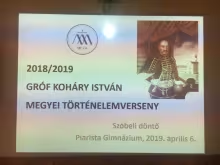
Péter Tusor, leader of the Fraknói Research Group participated as jury at the 'Count István Koháry History County Competition' organised by the Piarist Grammar School in Kecskemét on 6 April 2019. More than a hundred students enrolled in the competition, which celebrated it's 25th anniversary this year.
Count István Koháry played a major role in 17–18th century Hungary as a poet and politician, and he was also the founder of the Piarist school in Kecskemét (CV–Bio–Texts).
2019. April 20.
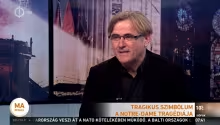
Péter Tusor, leader of the Fraknói Research Group gave an interview at M1 TV Channel on Holy Saturday about the historical symbolism of the Notre-Dame fire. The interview was also featured on Kossuth Rádió.
2019. May 7.
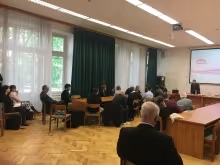
A book presentation was organised at the University of Pécs on 7 May 2019. The newly published book (edited by Tamás Fedeles, senior research fellow of the Fraknói Research Group) was presented by Norbert C. Tóth, and it contains the full studies of the lectures from the conference „King Mathias and the Church”, which has been organised last year with the contribution of the Fraknói Research Group. The book is also the tenth volume in the series Thesaurus Historiae Ecclesiasticae in Universitate Quinqueecclesiensi.
Just as on the conference, you can find studies in the compilation from several of our research group’s members: Péter Tusor, leader of the research group wrote about the Hungarian cardinal protectorate from the Hunyadi and Jagelló era; Tamás Fedeles on the Hungarian diplomats in the Holy See; and Terézia Horváth, assistant research fellow on the provosts of the collegiate chapter in Vasvár during the Hunyadi era.
In addition, two interesting projects were introduced at the event: the MTA–PTE–ELTE Hungarian Medieval Ecclesiastical Archontology Research Group 1000–1387 (leader: Márta Font); and the Diplomata Hungariae Antiquissima II. project (leader: Kornél Szovák).
2019. May 16.
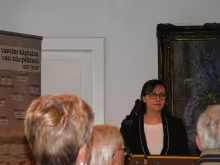
A conference was organised on 16 May 2019 in Vasvár, the place where the Fraknói Summer Academy have taken place last summer. On the occasion of the 800th year anniversary of the Vasvár collegiate's deed – which first mentions the surrounding settlements and originates from 1217 – the members of the current chapter were also present at the event.
Terézia Horváth, assistant research fellow of the Fraknói Research Group held a lecture on the conditions of the Vasvár collegiate institutional origins and gave insight into the early history of the office. She also examined the members of the collegiate from the 13th century and its activity as a place of document authentication.
Balázs Tangl talked about the history of the collection kept in the chapter's archives, and Zsombor Györffy-Villám presented the current results of the archaeological excavations, which have been taken place at the locations of the chapter-church two years ago.
The book Vasvári káptalan – Vasi települések. 1217–2017 (Chapter of Vasvár – Settlements of the county Vas. 1217–2017) was presented and praised by Miklós Melega.
2019. May 16.
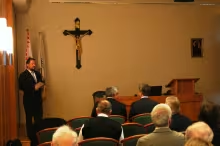
Demeter Naprághy, Archbishop of Kalocsa (1608–1619) and bishop of Győr (1607–1619) was remembered at the conference "Labore et patientia", which was devoted to him in Győr, 16 May 2019 for the 400th anniversary of his death. The Archives of the Diocese of Győr, The Treasury and Library of the Diocese of Győr and the Fraknói Research Group organized the event with Gábor Nemes, research fellow of the Fraknói Research Group.
Dr András Veress, bishop of Győr, and László Rózsavölgyi, representative of the city of Győr greeted the audience and praised the event. They also emphasized that importance of Naprághy's legacy. After that, the first section started under the chairmanship of Péter Tusor, leader of the Fraknói Research Group. Tamás Kruppa, research fellow of the Research Group gave a lecture on the activity of the humanist bishop in Transylvania.
The agenda of the conference and the list of the many other lectures can be accessed here.
2019. May 23.
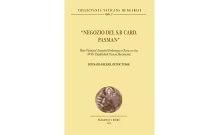
On the day of 23 May 2019 arrived the 401st year anniversary of the Thirty Years' War's (1618–1648) outbreak, the famous Second Defenestration of Prague. Thus it's no coincidence that the newest volume prepared in international research cooperation of the Fraknói Research Group got published on this very day, and it certainly pays off an old debt of the Hungarian and universal historiography (“Negozio del S.r Card. Pasman”. Péter Pázmány’s Imperial Embassage to Rome in 1632. (With Unpublished Vatican Documents) (CVH II/7), written and edited by Rotraud Becker, Péter Tusor, Budapest–Rome 2019.).
The tumultuous embassage of Péter Pázmány, cardinal of Hungary in 1632 is not just an important chapter regarding Hungarian-, church- and diplomatic history, but also an accentuated event to history of the papacy and the Thirty Years' War. It's modern and thorough investigation was also urged decades ago by the renowned expert of the era, George Lutz. The research has relied upon the documents of Pázmány’s embassage published in the 19th and 20th century (especially the documents written by Pázmány and partly the ones addressed to him); on the correspondence of the papal Secretariat of State and the nunciature of Vienna published by Rotraud Becker in 2013; on the verbals of the Secretariat of State published in this volume (about the papal audiences, the negotiations of Pázmány with Secretary of State Lorenzo Azzolini); on the discorsos and on the supplemental documents exploited in the Primatial Archives of Esztergom. During reading and analyzation, the historical atmosphere becomes real through the sources: more than 400 years later, the papal audiences and the negotiations with Secretary of State Azzolini evolve in front of the reader's eyes, and also a new, special perspective opens up due to the use of sources from the Vatican.
This closed side-project is the newest result of the Pázmány-research in the Vatican from the Fraknói Research Group (cf. CVH I/3, CVH I/13, CVH II/6), which has it's seat at the Pázmány Catholich University in Hungary.
The volume is in English, Chapter I–II can also be read in Hungarian; the sources were written in Italian as well as in Latin, of which usage is helped by their abstracts written in English and Hungarian. The English parts were translated by Ágnes Gátas-Palotai; while Rotraud Becker’s chapter (Chapter I) written in German was translated by András Forgó into Hungarian. The volume can be accessed here.
2019. May 23.
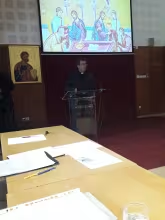
The 6th National Meeting of Church Historians was organised on 23 May 2019, where researchers and academics held a professional forum. The event was held in Nyíregyháza at the Saint Athanasius Greek Catholic Theological College, and the main organizer was Tamás Véghseő, rector of the institute and leader of the MTA–SzAGKHF Lendület Greek Catholic Research Group. Máté Gárdonyi, external associate of the Fraknói Research Group and professor of church history at PPKE HTK was the chairman of the meeting.
The conference consisted of three sections: the first one was about roman catholic subjects, the other two on greek catholic topics. In the first section, the questions of religion, nationality and identity were discussed from ethnographic and cultural perspectives through the examples of the Moldavian catholic communities and the settlement of Diósberény. The next section covered the awakening of national identity, and the relation between liturgy and multiethnicity in the 19th century, and provided a picture of the Greek Catholic Eparchy of Mukachevo (Munkács) during the 1848–1849 war of independence in Hungary. Finally, the last section was about the problematics of the 20th century in the Eparchy of Munkács and Eparchy of Hajdúdorog, mainly the questions of nationality, language use, the autonomy of the Rusyns and the Romanian-Hungarian relations.
2019. May 27.
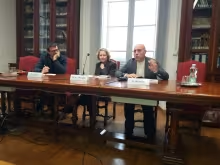
After the presentation organised by the Fraknói Research Group in Budapest (January 2019), the new book of Giampiero Brunelli, professor of Universitá Telematica San Raffaele, was presented in Rome, 27 May in the conference hall of the Biblioteca di Storia Moderna e Contemporanea. The book is discussing the role of the papacy in the Long Turkish War in Hungary (1593–1606). The new volume was praised by Vincenzo Lavenia, associate professor of the University of Bologna, researcher of Italian church history in the early modern period, and Maria Antonietta Visceglia, professor of the Sapienzia University, researcher of Rome in the early modern period and the history of the pre-modern papacy. They emphasized that the book – which was based on a long and thorough archival research process – covers the history of the three campaigns during the war in a complex yet readable way. Pope Clement VIII, promoter of the campaigns, named the expulsion of Ottoman forces his most important duty, which his motto ("marciare verso Constantinopoli") reflects clearly.
The significance of the presentation to the Hungarian science community is based on the fact that Brunelli's work deals with a specifically Hungarian subject.
2019. June 2.

Péter Tusor, leader of the Fraknói Research Group gave an interview at M1 TV Channel on 1 June 2019 about the historical aspects of the journey of Pope Francis in Transylvania. The live interview can be accessed here.
2019. June 14.
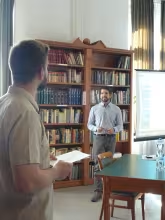
Assistant research fellow of the Fraknói Research Group, Viktor Kanász held a lecture at the doctoral conference Közvetítő rendszerek, médiumok és hatalomgyakorlás a kora újkori Európában (Intermediary Systems, Mediums and Exercise of Power in Early Modern Europe) at ELTE Szekfű Gyula Library on 5 June 2019. In his lecture (An Example of the Information Flow in an Early Modern Episcopate: Miklós Oláh's Testimony on György Fráter) he examined the connection between Miklós Oláh and György Fráter, how Oláh remembered the murdered cardinal in his testimony and what channels he gained information about his predecessor.
A week later on 14 June 2019, another conference (Conference of Doctoral Students in Medieval Studies) was organised at ELTE, where Terézia Horváth, assistant research fellow of the Fraknói Research Group held lecture on the institution of the collegiate in Vasvár. She presented the two sources which provide information about the institution, and she gave a hypothesis that the establishment is related to a certain bishop of Győr from the 12th century.
On the second day of the conference Viktor Kanász gave another lecture about the testament and Italian pilgrimage of László Kanizsai. In his lecture, he presented the sources on the pilgrimage and the previously unknown testament which preceded the journey.
2019. June 17.

Péter Tusor, leader of the Fraknói Research Group gave an interview at the Vatican Radio. He presented his newest volume (“Negozio del S.r Card. Pasman”. Péter Pázmány’s Imperial Embassage to Rome in 1632 (With Unpublished Vatican Documents) (CVH II/7), written and edited by Rotraud Becker, Péter Tusor, Budapest–Rome 2019.), which covers cardinal Péter Pázmány's imperial embassage to Rome in 1632 and it's diplomatic background.
The book contains lots of sources, and it's bilingual. It's available online here.
2019. June 26.
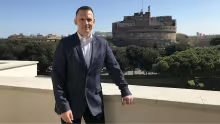
Two members of the Fraknói Research Group recently gave interviews for the Vatican Radio. While Tamás Fedeles spoke about the conference Italian Peninsula and Central-Eastern Europe between Middle Ages and Early Modern Era. Economy, Society, Culture, Péter Tusor presented the newest volume of the Fraknói Group, which was made under international cooperation. The book about the cardinal protectors discusses subjects from several symposiums in Rome and Viterbo.
2019. August 4.
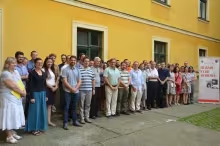
The fifth Fraknói Summer Academy was organized in Eger between 1–4 August 2019. Participants attended lectures on church history. Curators of the event were Péter Tusor and rev. Máté Gárdonyi, the director and organizer was Viktor Kanász.
On the first day the attendants were welcomed by the curators and the director. István Bitskey gave his lecture about the city of Eger in the 16th century. Thereafter he participated on a panel discussion about his scientific career.
On the second day of the Summer Academy, the latest results of the church history of Hungary were presented. The lectures included various presentation regarding the history of Archdiocese of Eger. The lecture was held by István Fazekas, Tamás Véghseő, Béla Vilmos Mihalik, Attila Verók. Furthermore Tamás Fedeles and Norbert C. Tóth presented György Domokos’s newest book. In the afternoon session of the academy program many more presentation were held in the topic by György Sági, Gábor Nemes, Xénia Jonica, Viktor Kanász and Róbert Oláh.
On Saturday the attendants visited the archbishop’s library. After the cultural program those present went hiking to the nearest hill, Nagy-Eged. To close the evening the director of Summer Academy, Viktor Kanász held a quiz on church history.
On the last day participants visited archbishop’s archives, and finally as usual those present participated a mass in the basilica of Eger.
2019. September 12.
Since the 16th of September under the organisation of Fraknói Research Group a permanent fellow worker position have been established in the Secret Archives of Vatican who also have access to research in the Apostolic Library of Vatican as well as to other Congregations’ archives nevertheless to the central archives of religious orders’ (thanks to external institutions financial contribution.)
Due to this residency more efficient work is foreseen which will be coordinated by Kornél Szovák and Péter Tusor. Therefore the organizers expect from the permanent fellow worker in Rome to help a wider range of hungarian researchers.
Obviously this new position is another step forward in the life of Research Group to reach the main purpose, namely a Hungarian Historical Institute in Rome.
2019. September 25.
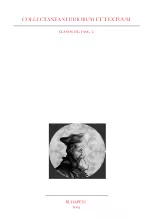
Since 2015 under the organisation of ’HAS–PPCU Lendület Research Group’ Fraknói Summer Academy have been existing. After 2017 the organizer institution of the Summer Academy has changed to ’HAS-PPCU Vilmos Fraknói Historical Research Group’. The Summer Academy’s main goal has always been to integrate the academic projects with the professional researching.
In order to integrate more efficiently a new sub-series has been launched by Fraknói Research Group therefore publishing the latest results that are presented in the Summer Academy. The new subseries named ’Lectures on Fraknói Summer Academy’. In the first part Bitskey István’s lecture has been published named as ’Bishops in the border castle’.
2019. September 27.
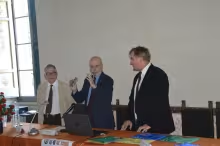
Last year Fraknói Research Group held an international conference in Budapest entitled ’The Agents of Foreign Communities and European-American States in Rome’. The conference focused on agents between 15th-18th centuries. This year the second part of the conference which payed attention to the 19th and 20th centuries was hold in Rome in the headquarters of the Istituto di Studi Romani. The event powered by Università della Tuscia DISUCOM, Istituto Nazionale di Studi Romani, the roman Centro Studi Emigrazione as well as MTA-PPKE Vilmos Fraknói Vatican Historical Research Group.
As a pursuance of the main thesis the role of the foreign agents in Rome was analogue in the 19th and 20th centuries as in earlier times.
For the international conference lecturer came from Italy, Austria and Hungary too, namely Alessandro Boccolini, Andreas Gottsmann, Oliver Panichi, Matteo Sanfilippo, Gaetano Platania, Francesca de Carpio, Krisztina Tóth, Balázs Rétfalvi and Péter Tusor.
Every lecture will be available until the end of October on the Researcher Group’s Youtube channel.
According to plans the lectures will be published as a volume of studies editing by Matteo Sanfilippo and Péter Tusor.
2019. October 9.
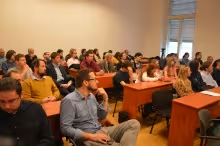
Fraknói Research Group held the 4th workshop on 9th of october 2019. The main goal of the occasion is to integrate the professional researching with the university education. This time Péter Tusor - leader of the Research Group - presented his common result with Rotraud Becker from Regensburg. Their latest work about Cardinal Péter Pázmány diplomatic route to Rome in 1632.
The presentation based on Rotraud Becker and Péter Tusor newest book which shows the baroque diplomatic life inside of the papal court. The authors used several unpublished source to their new book.
The english part is translated by Ágnes Gátas-Palotai and the german part is translated by András Forgó.
The lecture will be available until the end of October on the Researcher Group’s Youtube channel.
“Negozio del Ss.r Card. Pasman”. Péter Pázmány’s Imperial Embassage to Rome in 1632 (With Unpublished Vatican Documents) (Collectanea Vaticana Hungariae II/7), written and edited by Rotraud Becker, Péter Tusor, Budapest–Rome 2019. pp. 482. + 3 suppl. (2x2 pictures, 4 facsimilia) Digital supplements: http://institutumfraknoi.hu/en/repositorium/pazman_rome_1632
Az előadás ppt-je
Videó (előkészületben)
2019. October 31.

Thanks to the Research Group’s permanent fellow worker in Rome our website will be always up to date about scientific events in Rome. From November 2019 follow our „Events” heading where we give news about book presentations, conferences, exhibitions, etc.
Our purpose is to inform our collegues and followers about international scientific life and events.
2019. November 14.
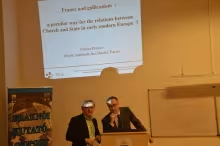
Olivier Poncet, professor and director of the Parisian École Nationale des Chartes held two lectures on 14th and 15th of November 2019 at Péter Pázmány Catholic University. The events were organized by Fraknói Research Group. The purpose of the events were to present the Vatican historical researching for the university students. From another aspect to cooperate with several international scholarly institutes. (In this case: École francaise de Rome )
On the first day professor Poncet gave a lecture entitled ‘France and gallicanism: a peculiar way for the relations between Church and State in early modern Europe?’. During the lecture Olivier Poncet divided into periods the occurrences of gallicanism. As well as he introduced the conflicts between the French kings and popes.
On the second day professor Poncet gave another lecture in historiography topic. His lecture entitled ‘A century in the Pope’s archives: what now? French research on pontifical Roman sources, 19th-21st century’. After it during the remarks session audience asked the professor about his researching and projects.
2019. November 16.
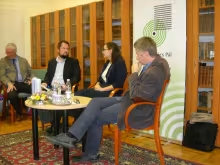
The Archontology of Chapter of Győr 1200–1458 was published in Győr by the Ecclesiastical Archives of Győr. The new book was presented on 16th November 2019 within the compass of the yearly Book Fair of Győr.
The authors of the new book were Norbert C. Tóth research fellow of MTA-HIM-SZTE-MNL OL Magyar Medievisztikai Kutatócsoport and Terézia Horváth research fellow of MTA-PPKE Vilmos Fraknói Vatican Historical Research Group. By reason of the new book Gábor Nemes research fellow of MTA-PPKE Vilmos Fraknói Vatican Historical Research Group was talking with authors about the co-working and the importance of archontologies.
2019. November 25.
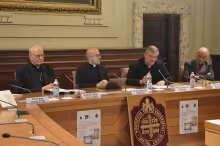
On 21st November 2019 Fraknói Research Group and Universitá della Tuscia DISUCOM presented they newly joint volume of studies in Rome namely Gli „angeli custodi”delle monarchia. I cardinali protettori delle nazioni. Professor Matteo Sanfilippo and Péter Tusor were the editors of the book which was published by Edizioni Sette Cittá. The aim of this volume is to introduce the institution and functions of cardinal protectors from the beginning until 18th century.
The event was held in Pontificia Universita Santa Croce’s great hall (Aula Benedetto XVI) where numerous inquiring was listening to Prof. Roberto Regoli’s Rev. Prof. Johannes Grohe’s Prof. Irene Fosi’s Prof. Gaetano Platania’s and Cardinal Péter Erdő’s lectures and comments on new volume.
2019. November 29.
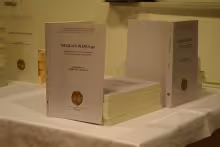
Publikationen der Ungarischen Geschichtsforschung in Wien (PUGiW) newly published book was presented in Vienna on 26 November 2019. The new volume of PUGiW namely Nicolaus Olahus 450 edited by Rita Emőke Szilágyi.
The book presentation was organised at the Collegium Hungaricum in Vienna where the editor and Christian Gastgaber (Institut für Mittelalterforschung, Österreichische Akademie der Wissenschaften) were presented the new volume. The aim of this book is to introduce Miklós Oláh’s life and main results of his activity as prelate of Hungary.
Viktor Kanász (Research fellow of Vilmos Fraknói Vatican Historical Research Group) also took part in the new volume with a paper named as Miklós Oláh’s Testimony Given during the Investigation of the Murder of György Fráter.
PUGiW’s ('alter idem' of Collectanea Vaticana Hungariae series) initiators were Péter Tusor and István Fazekas in 2009.
2019. December 13.
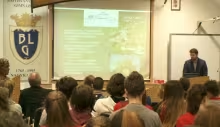
Viktor Kanász research fellow gave two lectures entitled ’Thúry György és Nagykanizsa’ on 13 December 2019.The event was organized by György Thúry Historical Open University at the headquarter of Lajos Batthyány High School.
The lectures payed attention to captain Thúry’s life and his work at Nagykanizsa. On the other hand Mr Kanász introduced Nagykanizsa’s early modern society to his audience as well as confessional and strategic affairs in the city.